 Catalina Island Snorkeling
The Captain Kidd Shipwreck, Dominican Republic
Last reviewed September 2026
One page from the Dominican tourism board describes the Captain Kidd shipwreck Dominican Republic waters hold as sitting "at 70 feet." That is a misreading of the record: the wreck lies 70 metres offshore, in 3 metres of water, shallow enough to see from the surface without a tank. This page sets out what the Quedagh Merchant actually is, how it was found, and why none of the snorkelling trips that pass this coast advertises a stop at it.
Quick answer The one wreck here you could snorkel over, and why none of the trips do
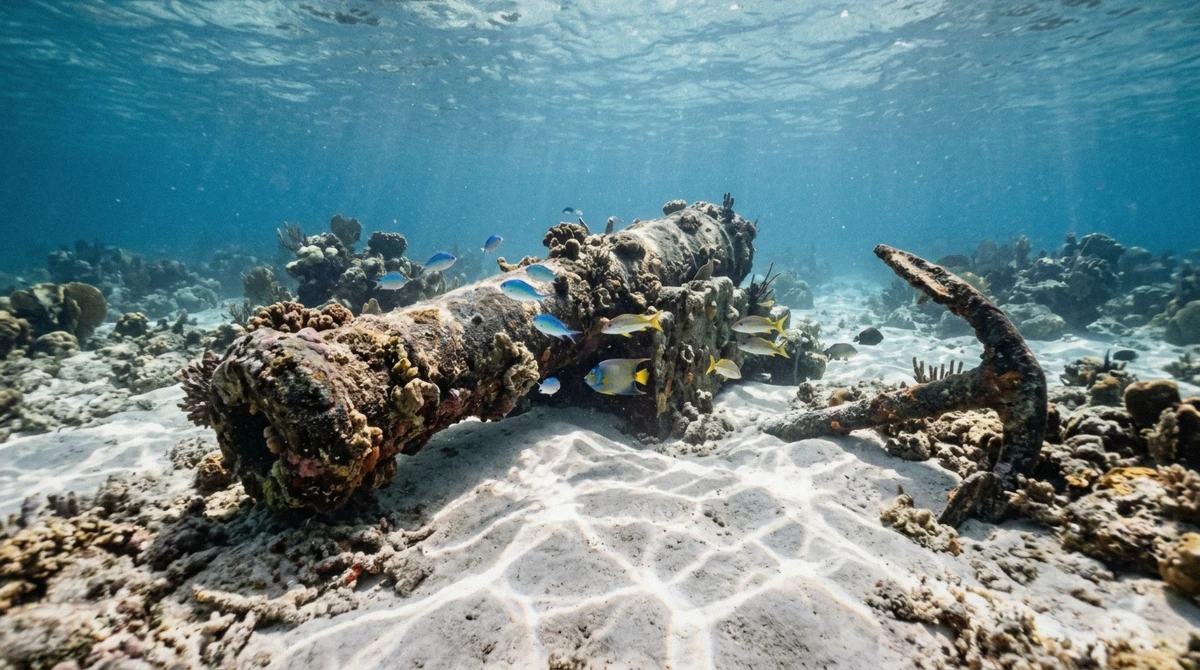
The wreck attributed to Captain Kidd, the Quedagh Merchant, was found on 13 December 2007 at just 3 m (10 ft) of depth, about 70 m (230 ft) off Isla Catalina's shore. That is shallow enough to snorkel, which is the entire reason this wreck is worth a page: the Dominican tourism board's own site describes it as sitting "at 70 feet," reading the offshore distance as a depth instead. Anchors and cannon are visible on the seabed, and it sits inside a Marine Protected Area, but no listing among the snorkelling trips that pass this coast advertises a stop there.
Key takeaways
- Found in 3 m (10 ft) of water: read how it was found for the 2007 survey
- The tourism board's "70 feet" figure is the offshore distance, not the depth: see what is visible, and at what depth
- Two deeper wrecks share this coast, the St. George and the Atlantic Princess, both dive-only
- It sits inside a nominated Living Museum in the Sea; the designation is explained under the Living Museum in the Sea
- None of the listings stops at it: read can you see it on a snorkelling trip
The Wreck, in One Paragraph
A pirate's prize, abandoned and forgotten
The wreck is what remains of the Quedagh Merchant, also recorded as the Cara Merchant, a 400-ton Armenian trading ship the pirate William Kidd captured in the Indian Ocean in 1698 and sailed home as his prize. He abandoned it in Caribbean waters near what is now the Dominican Republic in 1699, and it sat unidentified for more than three centuries before divers confirmed it. Today it rests close to shore, close enough that a strong swimmer with a mask could reach it without a boat, though nobody is advised to try that without local knowledge of the currents.
The wreck's location off Isla Catalina places it a short distance from waters that a handful of modern day-trip boats already cross on their way to entirely different destinations, built around the reef rather than the ship, and that gap between what is nearby and what is actually visited runs through the rest of this page.
How It Got There: Kidd, 1699 to 1701
A privateer turned pirate, and a ship he never went back for
William Kidd sailed from New York as a privateer with a royal commission to hunt pirates, and returned as one of the most wanted men of his era after seizing the Quedagh Merchant in 1698. Facing arrest on his way home, he switched to a smaller sloop and left the Quedagh Merchant in Caribbean waters in 1699, apparently expecting to retrieve it later. He was arrested in Boston, sent to London for trial, and hanged on 23 May 1701 without ever revealing where he had left the ship. For more than three hundred years afterward, the Quedagh Merchant's resting place stayed exactly that: a detail missing from an otherwise well-documented trial.
The gap between Kidd's abandonment of the ship and its eventual identification is the part of the story that explains why the site reads as a genuine discovery rather than a known landmark that simply took time to publicise. Kidd's trial, execution and general route through the Caribbean are documented in enough detail that historians could narrow down a search area; what nobody had was the ship itself, sitting the whole time in water shallow enough that a snorkeller could have swum over it decades earlier without knowing what was underneath.
How It Was Found, in 2007
An Indiana University team, and a storm that helped
A team from Indiana University located the wreck on 13 December 2007, close to the Dominican coast, in water shallow enough that earlier searchers had reportedly overlooked it precisely because nobody expected a pirate's flagship to be sitting in a snorkeler's depth range. The site had likely been exposed and re-covered by storms and shifting sand for centuries, which is part of why it went unidentified for so long despite sitting so close to shore.
The find fit a pattern that comes up again and again in shallow-water archaeology in this part of the Caribbean: a site that survives not because it is hard to reach, but because nobody had reason to look there. A 10-foot wreck 70 metres off a beach on a small, largely unvisited protected island is the kind of location that gets passed over by exactly the divers and researchers who would recognise it, simply because the depth reads as too shallow to be interesting to a technical dive team and too far offshore to be an obvious beachcomber's find.
What Is Visible, and at What Depth
The figures below come from the Wikipedia entry on the wreck and the Dominican tourism board's own page: the two disagree on how to read the same 70-metre figure, and the table makes the contradiction explicit rather than repeating either source uncritically.
Ten feet of water, not seventy
The Indiana University survey put the wreck at 3 m (10 ft) of depth, roughly 70 m (230 ft) offshore. The Dominican tourism board's own page states the wreck sits "at 70 feet", a figure that lines up with the offshore distance in metres, not the depth in feet, and reads as the two numbers getting swapped somewhere between the source data and the published copy. The practical difference matters: 10 feet is snorkel-shallow, visible from the surface on a calm day, while seventy feet is recreational-dive territory, out of reach for anyone without a tank and certification.
Anchors and cannon are visible on the seabed at the shallow, correct depth; 26 cannon were recovered from the site in total, and one of them is now on permanent display at the Children's Museum of Indianapolis.
| Detail | What the record shows | Source |
|---|---|---|
| Depth | 3 m (10 ft) | Wikipedia, citing the 2007 Indiana University survey |
| Distance offshore | About 70 m (230 ft) | Wikipedia |
| Tourism board's figure | "at 70 feet" | godominicanrepublic.com (reads the offshore distance as depth) |
| Cannon recovered | 26, one displayed in Indianapolis | Wikipedia; touringdominicanrepublic.com |
| Date found | 13 December 2007 | Wikipedia |
The Living Museum in the Sea
A protected wreck, not a salvage site
The wreck site is a Marine Protected Area and has been nominated as a Living Museum in the Sea, a designation used for shipwrecks and submerged sites where the cultural and biological material is protected in place rather than salvaged and removed. In practice that means the cannon and anchors that remain on the seabed are meant to stay there, visible to anyone who reaches the site rather than boxed in a case on land. It is the same underlying logic that governs the broader Monumento Natural Isla Catalina a short distance away: the boundary and its rules are set out in full on the island map page, which owns the geography and the protected-area figures for the wider area.
The practical effect of that status is a wreck that stays intact for as long as the designation holds. Twenty-six cannon recovered from a single site is an unusually large haul, and a Living Museum designation is the mechanism that keeps the remaining material from being picked apart one dive at a time by souvenir hunters. The one cannon on display in Indianapolis represents the pre-protection era of the find; everything documented since has stayed exactly where it was located.
The Other Wrecks Off Bayahibe
Bayahibe and La Romana form the country's main dive destination, with more than 20 official dive sites; the table below places the Quedagh Merchant against the two other named wrecks on the same stretch of coast, all figures from the Ministry of Tourism's own March 2026 release.
Three wrecks, one accessible without a tank
Bayahibe and La Romana together make up the Dominican Republic's main dive destination, with 20 official dive sites and visibility that the Ministry of Tourism says can exceed 20 to 30 m. Two other named wrecks sit on this same stretch of coast, and both are considerably deeper than the Quedagh Merchant: the St. George, a 73 m cargo ship deliberately sunk in 1999, rests at 30 to 40 m, and the Atlantic Princess, sunk in 2009, sits at about 12 m. Both require scuba certification; neither is within snorkeling range.
| Wreck | Type | Sunk / found | Depth | Reachable by snorkeling? |
|---|---|---|---|---|
| Quedagh Merchant | Pirate prize ship, abandoned 1699 | Found 13 December 2007 | 3 m (10 ft) | Yes, in theory; see can you see it on a snorkelling trip |
| Atlantic Princess | Deliberately sunk wreck | 2009 | ~12 m | No, dive certification required |
| St. George | 73 m cargo ship | 1999 | 30 to 40 m | No, deep, dive certification required |
Can You See It on a Snorkelling Trip?
In principle, yes. In practice, not through any listing here
At 3 m (10 ft), the Quedagh Merchant sits at a depth that a competent snorkeller can see clearly from the surface, and possibly free-dive to, on a calm day with good visibility. That is what makes it different from the St. George and the Atlantic Princess, which are simply out of reach without a tank. But depth alone does not make a stop bookable. None of the five listings compared on this site advertises a visit to the wreck; each one names The Wall or The Aquarium, or leaves the stop unnamed altogether, and none mentions Kidd's ship at all.
That gap is worth being direct about, in the spirit of naming a limitation rather than glossing over it: a traveler drawn specifically to this wreck should not assume any of the small-group tour, the Quetzal catamaran or the other listed trips will get them there. The site's location close to Isla Catalina puts it within the same general excursion zone the boats already operate in, but proximity is not an itinerary stop, and a specialist dive operator working out of Bayahibe (outside the scope of the day trips this site compares) is the more direct route to actually seeing it.
There is a reasonable explanation for the omission, beyond the trips simply not knowing the wreck exists. A boat that carries thirty or more shared-group snorkellers on a fixed schedule needs a stop with room to spread out and a bottom that tolerates dozens of fins and a rented mask being tried out for the first time. A shipwreck 70 m offshore, with genuine artifacts sitting exposed on the seabed and a nomination as a Living Museum, is closer in spirit to a dive-briefing site than a beginner stop, even at a snorkel-friendly 3 metres. That is a difference in purpose, not depth, and it is the kind of distinction a comparison table cannot show.
Captain Kidd's Shipwreck: Questions Travelers Ask
Where is Captain Kidd's ship wrecked?
Close to the Dominican coast near Isla Catalina, about 70 m (230 ft) offshore. The wreck is what remains of the Quedagh Merchant, Kidd's 1698 prize ship, which he abandoned there in 1699.
How deep is the Quedagh Merchant wreck?
3 m (10 ft), shallow enough to see from the surface. The Dominican tourism board's own page states the wreck sits "at 70 feet," which appears to read the 70-metre offshore distance as the depth rather than reporting the actual 3-metre figure from the 2007 survey.
Can you snorkel the Captain Kidd shipwreck?
The depth allows it, at 3 m (10 ft), but none of the snorkelling trips compared on this site advertises a stop there. A specialist dive or snorkel operator based in Bayahibe, working outside the scope of the day trips compared here, would be the way to actually visit it.
What is a Living Museum in the Sea?
A designation for a shipwreck or submerged site where the cultural and biological material is protected in place rather than salvaged and removed. The Quedagh Merchant site has been nominated for that status, and it also sits inside a Marine Protected Area.
What other wrecks are near Bayahibe?
The St. George, a 73 m cargo ship sunk in 1999 and resting at 30 to 40 m, and the Atlantic Princess, sunk in 2009 at about 12 m. Both require scuba certification; neither is within snorkeling range the way the Quedagh Merchant is.
How many cannon were found on the Quedagh Merchant?
26. One of them is now on permanent display at the Children's Museum of Indianapolis; the rest remain on the seabed at the protected site.
The Quedagh Merchant is a rare case where the more sensational-sounding claim is also the accurate one: a genuine pirate's ship, in water shallow enough to see without diving gear, sitting inside a protected marine site. The tourism board's own "70 feet" gets the number right and the unit wrong, which is a small error with an outsized effect on how the site reads to a visitor deciding whether it is within reach. It is, technically, within snorkelling depth.
But it is not on any of the trips that reach this coast for their own reasons, which are built around The Wall and The Aquarium rather than a wreck none of them names. Whether that changes with time depends on whether a specialist operator eventually builds a trip around it; for now, this wreck sits outside the Isla Catalina snorkeling roundup that compares the trips that do run.